Friday, March 27, 2020

Pope Francis’ Homily at Extraordinary ‘Urbi et Orbi’ Blessing

Pope Francis’ Homily at Extraordinary ‘Urbi et Orbi’ Blessing

Posted by POPE FRANCIS on Friday Mar 27th, 2020 at 5:06 PM

“You ask us not to be afraid. Yet our faith is weak and we are fearful. But you, Lord, will not leave us at the mercy of the storm.”

“When evening had come” (Mk 4:35). The Gospel passage we have just heard begins like this. For weeks now it has been evening. Thick darkness has gathered over our squares, our streets and our cities; it has taken over our lives, filling everything with a deafening silence and a distressing void, that stops everything as it passes by; we feel it in the air, we notice in people’s gestures, their glances give them away. We find ourselves afraid and lost. Like the disciples in the Gospel we were caught off guard by an unexpected, turbulent storm. We have realized that we are on the same boat, all of us fragile and disoriented, but at the same time important and needed, all of us called to row together, each of us in need of comforting the other. On this boat... are all of us. Just like those disciples, who spoke anxiously with one voice, saying “We are perishing” (v. 38), so we too have realized that we cannot go on thinking of ourselves, but only together can we do this. 

It is easy to recognize ourselves in this story. What is harder to understand is Jesus’ attitude. While his disciples are quite naturally alarmed and desperate, he stands in the stern, in the part of the boat that sinks first. And what does he do? In spite of the tempest, he sleeps on soundly, trusting in the Father; this is the only time in the Gospels we see Jesus sleeping. When he wakes up, after calming the wind and the waters, he turns to the disciples in a reproaching voice: “Why are you afraid? Have you no faith?” (v. 40). 

Let us try to understand. In what does the lack of the disciples’ faith consist, as contrasted with Jesus’ trust? They had not stopped believing in him; in fact, they called on him. But we see how they call on him: “Teacher, do you not care if we perish?” (v. 38). Do you not care: they think that Jesus is not interested in them, does not care about them. One of the things that hurts us and our families most when we hear it said is: “Do you not care about me?” It is a phrase that wounds and unleashes storms in our hearts. It would have shaken Jesus too. Because he, more than anyone, cares about us. Indeed, once they have called on him, he saves his disciples from their discouragement. 

The storm exposes our vulnerability and uncovers those false and superfluous certainties around which we have constructed our daily schedules, our projects, our habits and priorities. It shows us how we have allowed to become dull and feeble the very things that nourish, sustain and strengthen our lives and our communities. The tempest lays bare all our pre-packaged ideas and forgetfulness of what nourishes our people’s souls; all those attempts that anesthetize us with ways of thinking and acting that supposedly “save” us, but instead prove incapable of putting us in touch with our roots and keeping alive the memory of those who have gone before us. We deprive ourselves of the antibodies we need to confront adversity. 

In this storm, the façade of those stereotypes with which we camouflaged our egos, always worrying about our image, has fallen away, uncovering once more that (blessed) common belonging, of which we cannot be deprived: our belonging as brothers and sisters. 

“Why are you afraid? Have you no faith?” Lord, your word this evening strikes us and regards us, all of us. In this world, that you love more than we do, we have gone ahead at breakneck speed, feeling powerful and able to do anything. Greedy for profit, we let ourselves get caught up in things, and lured away by haste. We did not stop at your reproach to us, we were not shaken awake by wars or injustice across the world, nor did we listen to the cry of the poor or of our ailing planet. We carried on regardless, thinking we would stay healthy in a world that was sick. Now that we are in a stormy sea, we implore you: “Wake up, Lord!”. 

“Why are you afraid? Have you no faith?” Lord, you are calling to us, calling us to faith. Which is not so much believing that you exist, but coming to you and trusting in you. This Lent your call reverberates urgently: “Be converted!”, “Return to me with all your heart” (Joel 2:12). You are calling on us to seize this time of trial as a time of choosing. It is not the time of your judgement, but of our judgement: a time to choose what matters and what passes away, a time to separate what is necessary from what is not. It is a time to get our lives back on track with regard to you, Lord, and to others. We can look to so many exemplary companions for the journey, who, even though fearful, have reacted by giving their lives. This is the force of the Spirit poured out and fashioned in courageous and generous self-denial. It is the life in the Spirit that can redeem, value and demonstrate how our lives are woven together and sustained by ordinary people – often forgotten people – who do not appear in newspaper and magazine headlines nor on the grand catwalks of the latest show, but who without any doubt are in these very days writing the decisive events of our time: doctors, nurses, supermarket employees, cleaners, caregivers, providers of transport, law and order forces, volunteers, priests, religious men and women and so very many others who have understood that no one reaches salvation by themselves. In the face of so much suffering, where the authentic development of our peoples is assessed, we experience the priestly prayer of Jesus: “That they may all be one” (Jn 17:21). How many people every day are exercising patience and offering hope, taking care to sow not panic but a shared responsibility. How many fathers, mothers, grandparents and teachers are showing our children, in small everyday gestures, how to face up to and navigate a crisis by adjusting their routines, lifting their gaze and fostering prayer. How many are praying, offering and interceding for the good of all. Prayer and quiet service: these are our victorious weapons. 

“Why are you afraid? Have you no faith”? Faith begins when we realise we are in need of salvation. We are not self-sufficient; by ourselves we founder: we need the Lord, like ancient navigators needed the stars. Let us invite Jesus into the boats of our lives. Let us hand over our fears to him so that he can conquer them. Like the disciples, we will experience that with him on board there will be no shipwreck. Because this is God’s strength: turning to the good everything that happens to us, even the bad things. He brings serenity into our storms, because with God life never dies. 

The Lord asks us and, in the midst of our tempest, invites us to reawaken and put into practice that solidarity and hope capable of giving strength, support and meaning to these hours when everything seems to be floundering. The Lord awakens so as to reawaken and revive our Easter faith. We have an anchor: by his cross we have been saved. We have a rudder: by his cross we have been redeemed. We have a hope: by his cross we have been healed and embraced so that nothing and no one can separate us from his redeeming love. In the midst of isolation when we are suffering from a lack of tenderness and chances to meet up, and we experience the loss of so many things, let us once again listen to the proclamation that saves us: he is risen and is living by our side. The Lord asks us from his cross to rediscover the life that awaits us, to look towards those who look to us, to strengthen, recognize and foster the grace that lives within us. Let us not quench the wavering flame (cf. Is 42:3) that never falters, and let us allow hope to be rekindled. 

Embracing his cross means finding the courage to embrace all the hardships of the present time, abandoning for a moment our eagerness for power and possessions in order to make room for the creativity that only the Spirit is capable of inspiring. It means finding the courage to create spaces where everyone can recognize that they are called, and to allow new forms of hospitality, fraternity and solidarity. By his cross we have been saved in order to embrace hope and let it strengthen and sustain all measures and all possible avenues for helping us protect ourselves and others. Embracing the Lord in order to embrace hope: that is the strength of faith, which frees us from fear and gives us hope. 

“Why are you afraid? Have you no faith”? Dear brothers and sisters, from this place that tells of Peter’s rock-solid faith, I would like this evening to entrust all of you to the Lord, through the intercession of Mary, Health of the People and Star of the stormy Sea. From this colonnade that embraces Rome and the whole world, may God’s blessing come down upon you as a consoling embrace. Lord, may you bless the world, give health to our bodies and comfort our hearts. You ask us not to be afraid. Yet our faith is weak and we are fearful. But you, Lord, will not leave us at the mercy of the storm. Tell us again: “Do not be afraid” (Mt 28:5). And we, together with Peter, “cast all our anxieties onto you, for you care about us” (cf. 1 Pet 5:7). 

[Original text: Italian] 
Pix by Charles 

Tuesday, January 21, 2020

Buried for 50 years: Britain’s shameful role in the Biafran war Frederick Forsyth

Buried for 50 years: Britain’s shameful role in the Biafran war

A million children starved to death. I’m haunted by the images I saw there – and by the complicity of the Wilson government
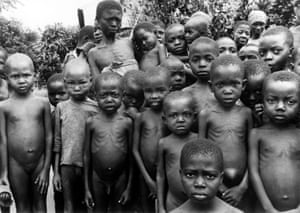
Starving children in a refugee camp near Aba in 1968.
It is a good thing to be proud of one’s country, and I am – most of the time. But it would be impossible to scan the centuries of Britain’s history without coming across a few incidents that evoke not pride but shame. Among those I would list are the creation by British officialdom in South Africa of the concentration camp, to persecute the families of Boers. Add to that the Amritsar massacre of 1919 and the Hola camps set up and run during the struggle against Mau Mau.
But there is one truly disgusting policy practised by our officialdom during the lifetime of anyone over 50, and one word will suffice: Biafra.
This referred to the civil war in Nigeria that ended 50 years ago this month. It stemmed from the decision of the people of the eastern region of that already riot-racked country to strike for independence as the Republic of Biafra. As I learned when I got there as a BBC correspondent, the Biafrans, mostly of the Igbo people, had their reasons.
The federal government in Lagos was a brutal military dictatorship that came to power in 1966 in a bloodbath. During and following that coup, the northern and western regions were swept by a pogrom in which thousands of resident Igbo were slaughtered. The federal government lifted not a finger to help. It was led by an affable British-educated colonel, Yakubu Gowon. But he was a puppet. The true rulers were a group of northern Nigerian colonels. The crisis deepened, and in early 1967 eastern Nigeria, harbouring about 1.8 million refugees, sought restitution. A British-organised conference was held in Ghana and a concordat agreed. But Gowon, returning home, was flatly contradicted by the colonels, who tore up his terms and reneged on the lot. In April the Eastern Region formally seceded and on 7 July, the federal government declared war.
Biafra was led by the Eastern Region’s Oxford-educated former military governor, “Emeka” Ojukwu. London, ignoring all evidence that it was Lagos that reneged on the deal, denounced the secession, made no attempt to mediate and declared total support for Nigeria.
I arrived in the Biafra capital of Enugu on the third day of the war. In London I had been copiously briefed by Gerald Watrous, head of the BBC’s West Africa Service. What I did not know was that he was the obedient servant of the government’s Commonwealth Relations Office (CRO), which believed every word of its high commissioner in Lagos, David Hunt. It took two days in Enugu to realise that everything I had been told was utter garbage.
I had been briefed that the brilliant Nigerian army would suppress the rebellion in two weeks, four at the most. Fortunately the deputy high commissioner in Enugu, Jim Parker, told me what was really happening. It became clear that the rubbish believed by the CRO and the BBC stemmed from our high commissioner in Lagos. A racist and a snob, Hunt expected Africans to leap to attention when he entered the room – which Gowon did. At their single prewar meeting Ojukwu did not. Hunt loathed him at once.
My brief was to report the all-conquering march of the Nigerian army. It did not happen. Naively, I filed this. When my report was broadcast our high commissioner complained to the CRO in London, who passed it on to the BBC – which accused me of pro-rebel bias and recalled me to London. Six months later, in February 1968, fed up with the slavishness of the BBC to Whitehall, I walked out and flew back to west Africa. Ojukwu roared with laughter and allowed me to stay. My condition was that, having rejected British propaganda, I would not publish his either. He agreed.
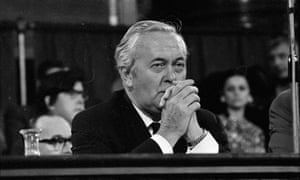
Harold Wilson
 ‘Weapons and ammunition poured in quietly as Whitehall and the Harold Wilson government lied and denied it all.’ Photograph: Wood/Getty Images
But things had changed. British covert interference had become huge. Weapons and ammunition poured in quietly as Whitehall and the Harold Wilson government lied and denied it all. Much enlarged, with fresh weapons and secret advisory teams, the Nigerian army inched across Biafra as the defenders tried to fight back with a few bullets a day. Soviet Ilyushin bombers ranged overhead, dropping 1,000lb bombs on straw villages. But the transformation came in July.
Missionaries had noticed mothers emerging from the deep bush carrying children reduced to living skeletons yet with bloated bellies. Catholic priests recognised the symptoms – kwashiorkor or acute protein deficiency.
That same July the Daily Express cameraman David Cairns ran off a score of rolls of film and took them to London. Back then, the British public had never seen such heartrending images of starved and dying children. When the pictures hit the newsstands the story exploded. There were headlines, questions in the House of Commons, demonstrations, marches.
As the resident guide for foreign news teams I became somewhat overwhelmed. But at last the full secret involvement of the British government started to be exposed and the lies revealed. Wilson came under attack. The story swept Europe then the US.
Donations flooded in. The money could buy food – but how to get it there? Around year’s end the extraordinary Joint Church Aid was born.
The World Council of Churches helped to buy some clapped-out freighter aircraft and gained permission from Portugal to use the offshore island São Tomé as a base. Scandinavian pilots and crew, mostly airline pilots, offered to fly without pay. Joint Church Aid was quickly nicknamed Jesus Christ Airlines. And thus came into being the world’s only illegal mercy air bridge.
On a visit to London in spring 1969 I learned the efforts the British establishment will take to cover up its tracks. Every reporter, peer or parliamentarian who had visited Biafra and reported on what he had seen was smeared as a stooge of Biafra – even the utterly honourable John Hunt, leader of the Everest expedition.
Throughout 1969 the relief planes flew through the night, dodging Nigerian MiG fighters, to deliver their life-giving cargoes of reinforced milk powder to a jungle airstrip. From there trucks took the sacks to the missions, the nuns boiled up the nutriments and kept thousands of children alive.
Karl Jaggi, head of the Red Cross, estimated that up to a million children died, but that at least half a million were saved. As for me, sometimes in the wee small hours I see the stick-like children with the dull eyes and lolling heads, and hear their wails of hunger and the low moans as they died.
What is truly shameful is that this was not done by savages but aided and assisted at every stage by Oxbridge-educated British mandarins. Why? Did they love the corruption-riven, dictator-prone Nigeria? No. From start to finish, it was to cover up that the UK’s assessment of the Nigerian situation was an enormous judgmental screw-up. And, worse: with neutrality and diplomacy from London it could all have been avoided.
Biafra is little discussed in the UK these days – a conflict overshadowed geopolitically by the Vietnam war, which raged at the same time. Yet the sheer nastiness of the British establishment during those three years remains a source of deep shame that we should never forget.
 Frederick Forsyth is a former war correspondent and an author


From;
https://www.theguardian.com/commentisfree/2020/jan/21/buried-50-years-britain-shamesful-role-biafran-war-frederick-forsyth

Thursday, November 7, 2019

BEAUTIFUL FROM THE HEART

A great amazon with a beautiful heart that eloquently radiated on her face.A great heart that touched and continue to touch many through her legacies.
Its 20 years today you left us (too early) but with the greatest gift on earth :PEACE & LOVE for all.

You lagecies will always be upheld.
Continue to Rest in peace mama.

Thursday, October 31, 2019

CHIEF CYPRIAN IBEKWEUDE.. REST IN PEACE

 THE  DEPARTURE  OF A GREAT FATHER AND MAN OF PEACE CHIEF CYPRIAN IBEKWEUDE;  31st November 2019.
 It is naturally painful to miss a figure that has always been present in your life  and memory, but  we  give  the utmost glory  and thanks  to God  for the  blessed time  and life he accorded  to  Pa Ibekwe which he  used to impress positively on  the  community and everyone that came across him.
We in the Chukwubike’s family grew up  knowing his wife(firstly) whom we called ‘Sister Angelina David’. Then we didn’t know the differences  between a Rev Sister and a Nurse because most nurses in our locality  were Rev Sisters  and our Angelina was also a young devoted catholic from a top disciplined family.
She was like  a daughter  to our  father therefore when the young man Cyprian started marrying her we all came to know that ‘Sister was a Nurse’.
Cyprian was a fine and vibrant gentleman and was accepted by her family and MBC also endorsed it.
Pa Ibekwe was was a great father who as a typical Igboman devoted all (without showing it ) his energies to the discipline  and development of  his  family and community.
When he lived  outside Nenwe because of  his business he never missed  to  return regularly  and promptly to attend  to issues in the family  and on every return he never missed to pay homages to MBC. He  relied  so much on my fathers supervision of his  young family and our NURSE was  and is still a fantastic mother.
Pa Ibekwe was  a disciplined person and was lucky to have married  someone  from a strict  disciplined  and educational (catholic) background  no wonder they were blessed  with wonderful children {who one of them is our able and beloved Rev Fr Johnbosco } that  a couple of years ago feasted and honoured  them alive  during their wedding anniversary.We are proud  of these children and  for  setting that pace  for others to follow.
In the community Chief Ibekwe never had  any issues  with anyone in the town. He was always in the midst of all peace movements and committees.
We in the Chukwubike’s  family will always  remember him for  his continuous  closeness to us , especially to our parents  when we  were away and they were sick. We shall always be grateful how  he  and his   wife  continued  to be  their(our parents)  special  family  ‘chief  doctor and nurse’. These priceless friendship and services  will always  be  remembered. As we remember so do others remember him for  his services  to all the families  at home who he continued  to  support in all the ways  he could.
As we say good bye  today  we pray   to the  Good  Lord  to accept your  soul , grant your  wife   and all of  us  the  heart to bear your physical  absence.
Rest in peace
From
Charles O Chukwubike
(for the Chukwubikes family)

Friday, September 13, 2019

SENATOR UBAH COMMENDS AIR PEACE

 SENATOR IFEANYI UBAH COMMENDS AIR PEACE FOR COMING TO THE RESCUE OF DISPLACED NIGERIANS IN SOUTH AFRICA, URGES FEDERAL GOVERNMENT TO CONTINUALLY SUPPORT LOCAL INVESTORS.

I am extremely delighted to join every well meaning Nigerian in commending Chief. Allen Onyema and the entire management of Air Peace for the brilliant and exceptional display of patriotism displayed by virtue of his move to airlift stranded Nigerians in South Africa.

It is indeed a thing of profound joy to witness such a selfless and epoch making gesture coming from my brother and constituent who has not only set a new benchmark in the Nigerian aviation sector, but has also actively taken part in humanitarian efforts to aid Nigerians who have been forcibly displaced as a result of the xenophobic attacks in South Africa. The speedy evacuation of these displaced and stranded Nigerians from South Africa has attracted tremendous respect to both the government and citizens of Nigeria on the international scene.  

Chief Allen Onyema is a man who has come so far from his humble beginnings, but has never forgotten what it feels like to struggle, and this memory informs his generosity and dedication to patriotism. 

I am beyond pleased with this show of selflessness which epitomizes the true meaning of patriotism. Once more, I wish to commend Chief Allen Onyema for this timely intervention which has placed him on the pedestal of “Heroes” who will be remembered by posterity for their legacy of sacrifice and patriotism to our nation in the face of devastating crisis. 

When I saw the capacity of Air Peace and fought vigorously for the protection of the company’s interests on the floor of the Senate, a lot of eye brows were raised. Today, Chief Onyema’s action has vindicated my stance and proven to Nigerians the importance of local investors and the protection of their investments like it is done in every other country. 

I am proud of the fact that he deployed one of his best aircrafts; a Boeing 777 to make this remarkable sacrifice for our dear nation out of his fleet of  28 airplanes and 20 brand new firm placed orders. 

It is worthy of note to remind Nigerians and the world that this gesture must have cost Chief Allen Onyema millions of dollars as he did this ”Free of Charge” for our nation. This is also not the first time that Chief Allen Onyema would be placing national interest and patriotism over self interest. The general public would vividly recall that he used his philosophy of Noviolence to fight the incidence of violent militancy in the Niger Delta, training and transforming the militants during the Niger Delta uprising and engaging the restive youths in National reconciliation programmes which eventually led to the proclamation of amnesty to the ex-militants. 

Conclusively, I want to ask; Can any foreign airline operating in Nigeria do this for Nigerians? The answer is; No.

It is imperative that we, as a nation, must not only take note of such persons of rare qualities but should also promote and encourage such citizens with formidable contributions to the nation’s economy. This is why I am using this medium to urge the Federal Government to continually support our indigenous investors and provide critical infrastructure that would make the nation’s environment conducive for private businesses to thrive because they are the ones that donate their personal resources for succor and societal support when critical situations like this arise. The protection of the business interests of these local investors should be a priority to the Government, so that they can be able to do more for the society. 

Senator (Dr.) Patrick Ifeanyi Ubah,
Anambra South Senatorial District


Thursday, September 12, 2019

ABUJA & YOU

ABUJA AND YOU 

Abuja is probabaly the worst-hit of Nigerian cities by this recession. It is only understandable: Abuja works at nothing but revels in wanton opulence, fed strictly from pens adding zeroes behind a whole number. It's buildings are populated with straw companies gliding on patronage and privilege, not rights, merit and productivity. Most of its inhabitants are currently in what seems a state of disbelief, if not shock. 

My son and I walked lazily to Sheraton two Saturdays ago and from the gate you got a surprise: no line of traffic! The lounge was empty as the car park was vacant. We sat in surprise at the little corners of decay creeping on the lounge, part of which was even poorly lit. Of course, even Maitama and Asokoro are wrapped in thick darkness these days at 8pm if grid power fails. 

I was surprised at the black silence I met in these desolate palaces. Everywhere signs hang on homes and high-rise office buildings begging for tenants. I called a number on one and the voice that answered said it was for sale: 3.6billion, seven-story building with a footprint of about 250sqm. "I see".

There is good hiding in evil and sometimes you don't even have to look too deeply to see it. Too many wealth in Nigeria is strictly in figures without any underlying source or feeder spring. If you got your money through work and creativity; if they put you in a desert, you will still replicate the feat. 

What is called a recession in regular economics is but a dethronement of false money, the overthrow of pretenders and wealth built with the tip of a pen so that reality and productivity can take over. It is an inevitable passage if nature is correctly programmed. 

In a hilarious circle I was told about a typical Abuja moneybag whose fortune has now turned around. He was in money - and you know what I mean. In height of his affluence he collected two more wives to make a total of three. But the noose had been getting tighter and, all streams gone dry, he applied for a loan from a bank. Not so well exposed to the hazard of seeking credit from Nigerian banks, he was exceedingly positive he will soon be credited and so went with gusto to the manager's office on an appointed day to get the final answer on his application. 

When he was told that he had been turned down, he lost control of himself so completely that he pooped on himself right there in the bank. He was helped into the bathroom and offered a ton of tissues and when he had become manageable, they led him into a taxi and gave him a thousand naira to the bank's happy ending of the personal tragedy. 

The story teaches us that wealth without foundation will end in sudden failure. It is not only Abuja or the typical, overweight Nigerian big man, Nigeria itself is a victim of lazy wealth: oil is not a result of hard work or creativity. We don't even as much as have local capacity to drill the oil! If we don't build our economy by adding value through processing and developing our human resources, we won't end up much better than that poor individual you just laughed at."

My view:

It is time to start building real and sustainable wealth, enough of what used to be...The difference between the poor and rich nations  is not the age of the Nation. This can be demonstrated by countries like India and Egypt, which are more than 2000 years old and are still poor countries.

On the other hand, Canada, Australia and New Zealand, which 150 years back were insignificant, today are developed and rich countries.

The difference between the poor and rich nation does not also depend on the available natural resources.

Japan has limited territory, 80%  mountainous, unsuitable for agriculture or farming, but is the second in worlds economy. The country is like an immense floating factory, importing raw material from the whole world and exporting manufactured products.

Second example is Switzerland, it does not grow cocoa but produces the best chocolates in the world. In her small territory she rears animals and cultivates the land only for four month in a year, nevertheless manufactures the best milk products. A small country which is an image of security which has made it the strongest world bank.

Executives from rich countries who interact with their counterparts from poor countries show no significant intellectual differences.

The racial or colour factors also do not evince importance: migrants heavy in laziness in their country of origin are  forcefully productive in rich European countries.

What then is the difference?

The difference is the attitude of the people, moulded for many years by education and culture.
Loading...

When we analyse the conduct of the people from the rich and developed countries, it is observed that a majority abide by the following principles of life:

1. Ethics, as basic principles.
2. Integrity.
3. Responsibility.
4. The respect for Laws and Regulations.
5. The respect from majority of citizens by right.
6. The love for work.
7. The effort to save and invest.
8. The will to be productive.
9. Punctuality.

In the poor countries a small minority follow these basic principles in their daily life.

We are not poor because we lack natural resources or because nature was cruel towards us.

We are poor because we lack attitude. We lack the will to follow and teach these principles  of working of rich and developed societies.

WE ARE IN THIS  STATE  BECAUSE
WE WANT TO TAKE ADVANTAGE  OVER
EVRYTHING AND EVERYONE.

WE ARE IN THIS  STATE  BECAUSE
WE  SEE  SOMETHING  DONE  WRONG
AND SAY  - “LET IT BE”
WE  SHOULD  HAVE  A  SPIRITED MEMORY
AND  ATTITUDE…

ONLY THEN WILL WE BE ABLE TO CHANGE  OUR  PRESENT  STATE.

If you do not share this message, nothing is going to happen to you. Your prized animal is not going to die, you wont be sacked from your job, you wont be having bad luck for seven years, nor are you going to get sick.

But, if you love your COUNTRY, try and circulate this message so that as many people may read and see what our problems are and hopefully move to change themselves to change the country.
(COPIED)

Saturday, August 31, 2019

THE WALK TO THE NEW BIAFRA :YES WE CAN . BY CLEM EBERE


 http://igbomade.blogspot.com/2019/08/the-walk-to-biafra.html

Clem Ebere replies  to the link above ðŸ‘†

Wao!  GBAM!!
This is the Biafra I have always spoken about whenever and wherever I talk about Biafra.. This is the Biafra I believe in. This is the Biafra that will save the Igbo people. This is the Biafra that will fight no war to be. This is the Biafra I belong!

A redefinition of "Biafra" in context and content. That is what I have been advocating and telling those who care to hear.

We should learn from history, and stop the self delusion of openly inviting self destruction, by allowing those that defeated us about 50 years ago, to reduce us again.  To reduce Igboland to a wadteland, to correct their mistake of not wiping the Igbos s out of the surface of the earth 50 years ago. 

The new Biafra should be won through wisdom, the new Biafra should be won without firing guns, the new Biafra should exist without escalating  the experimental  "Python dance or egwu- eke" to all igboland,  the new Biafra should be be won through a deliberate strategy to empower the entire igboland and Igbo people, psychologically,   economically, technologically with sound infrastructure to unleash mass flourishing in Igbo land. 

The new Biafra is the Biafra of the mind. A mindset for Igboland to dominate  Nigeria, and indeed West Africa economically. A mindset and demonstrable industrial prowess that will endue the power and strength unimaginable and indomitable by any political power in Nigeria.  The new Biafra will bemuse other regions to utter awe and profound admiration of the Igbo people.

Why should the new Biafra take that route? :
1) It is safer, no soul will be lost!
2) It is doable! It is our birth right, because we are industrious,. Eastern Nigeria had once won the world rating as the fastest developing region in west Africa, and we can do it again!
3) The Igbos are positioned to do it. They have commerce in their hand, they have investors in their midst, their intelligentsia are everywhere in the world, we are daring and have our people in business and industry, everywhere.
4) We have a waiting and willing population of commercial operators to command the market forces operating in West Africa, Central Africa, Southern Africa to depend on a developed market in Igboland.
5) The issue of leadership which will definitely  bedevil a nascent Igbo nation, if ever fought and won, will now be removed, as all efforts and energies for political powers and control will be concentrated to Nigeria as an entity. This will remove the secession curse, as witnessed in Southern Sudan.

My brothers, you would agree with me that majority of us in this forum are nominally Biafran, by sympathy and by default as Igbomen, but very few are card carrying members of IPOB or MASSOB.  You would also agree with me, that as the new Biafra is created or championed, most of us will become part of it as full  and active members.
Come to think of it, how did China emerge as the greatest Political force in the 21st century?  Simply, because they became the largest economy in the world, the factory of the world, the largest trading partner to USA, European Union, Africa, etc. China rules the world economically and are prepared to rule politically.
So, new Biafra or Ndi- Igbo can can rule Nigeria and west Africa economically , and later take rule Nigeria Politically.

Yes. We have started it. Let us replicate the Nnewi industrialization experiment in a grand and strategic scale in entire Igbo Land.  Let us create the enabling environment through the organized private sector, in collaboration with government to do it. Let us reactivate and unleash the latent energies and the inborn  entrepreneurial spirit of Igbo sons and daughters including those in the diaspora to create the largest economic zone in West Africa called Biafra, and not a secessionist Zone in Nigeria called Biafra.
YES, WE CAN DO IT!. LET US DO IT.
By  Clem Ebere

COMMENTS

SHAITSU

SHAITSU
Il massaggio Shiatsu che si effettua tramite la pressione delle dita, dei palmi delle mani e dei piedi e dei gomiti su tutto il corpo, agisce sui punti energetici considerati dall'agopuntura. Stimola la circolazione sanguigna ed il flusso linfatico, agisce sul sistema nervoso allentando la tensione muscolare più profonda, rimuove le tossine dei tessuti, risveglia il sistema ormonale e sollecita la capacità di autoguarigione del corpo.

FeedCount

Live Traffic Feed

Followers