Thursday, September 10, 2020

THE IGBO SPIRIT


THE IGBO SPIRIT


 *PETER ALEXANDER ASHIKIWE ADIONE EGOM; the Legendary “MOTOR-PARK ECONOMIST” wrote this article before he died on March 3, 2013, aged 70.*


*THE IGBO SPIRIT:*


I am of the Igbo stock from Ukala-Okpunor in Oshimili North LGA of Delta State. I am 61 years of age annd have from late 1965, during my undergraduate days at Downing College, Cambridge, England, been fascinated by my people, the Igbo, and specifically by what makes them such a pulsating enigma of a people.


It was, indeed, a chance remark by the late and distinguished scholar in Social Anthropology at Cambridge, Professor Meyer Fortes, which set me on my lifelong journey of private enquiry into the ethno-spiritual makeup of the Igbo. My then larger-than-life and boon companion was my fellow undergraduate at the Cambridge University faculty for Archaeology and Anthropology, Mallam Ibrahim Tahir of BBC Bush House fame. As was our wont, we were on this particular autumn afternoon having tea at a teashop that was just across Ibrahim's King's College when our Professor in Social Anthropology, Meyer Fortes, walked in and sat with us for a chat. One thing led to another and we soon found ourselves discussing ethno-types in Africa.


Professor Fortes had been one of the bright lights in Lord Bailey's team of Africanists that did the regular tome of Africa Survey for the British Foreign and Colonial Office. And Professor Fortes told us that, according to Lord Bailey, the Igbo, out of the legion of African ethnic groups they studied, were the least encumbered with any cultural baggage. In a manner of speaking, the Igbo come light and go light with the baggage of culture.


Of course, Professor Fortes assumed that Ibrahim and myself knew what Lord Bailey meant with the concept of cultural baggage and did not venture into any explanation of it. But as soon as he took his leave of us, Ibrahim and myself fell to a very passionate but friendly discussion of this hazy concept. And, if my memory serves me right, we eventually let the matter be without agreeing on what the concept of cultural baggage stands for. But there was something, which my mind could not let be after this encounter. I had to know more about my people, the Igbo, who come light and go light with the baggage of culture.


My lecturer in Social Anthropology at Cambridge, Mr. G. 1. Jones an ex-colonial administrator in the Eastern Region of Nigeria, and an Igbophil of sorts, was on hand to give me advice on where to find materials on the Igbo. And what I could glean from the diverse tomes of Igbo historical and ethnographical that came my way was this. There was no love lost between the European slave-dealers and colonialists and the Igbo either on the continent of Africa or in the Diaspora. Igbo slaves were difficult to handle, prone to rebellion and bad for the economy of the slave-owner. And, the fear of the Igbo was, in a manner of speaking, the beginning of economic wisdom among European slave-owners and, later, colonialists.


The Igbo was a troublemaker and a troubleshooter in bondage as one saw in Haiti in the rebellious years leading up to the overthrow of the French and the independence of the island in 1805 and in the Southern States of North America where Igbo slaves jumped into the sea rather than face slavery! So, the Igbo were bad news as a slave. And in the restricted freedom of colonial Nigeria, as the colonialists saw to their continued irritation, the Igbo was uppity, difficult to convince and difficult to lead. He was never really the darling of the mandarins of the British Foreign and Colonial Office at Whitehall, London!


But, all of the above was what European predators thought about the Igbo! I was not satisfied with it. I wanted to know what made the Igbo uppity, difficult to convince and difficult to lead in the restricted freedom of colonial Nigeria and what made him a troublemaker and troubleshooter in the bondage of slavery abroad. I simply wanted to touch the Igbo spirit in order to better understand who I am. And the books I read then in England could not lead me anywhere in this direction. And so I shelved the project of my search for the essential attributes of the Igbo without knowing whether I would ever come back to it.


But, did I really shelve this project? Not at all. For what I failed to realize at this time in Cambridge is that I had begun a lifelong journey of an inquiry into my essential, I as a member of the Igbo stock and that this project could never be shelved until the very day I died. Indeed, my search for what makes the Igbo what he is my search for my true identity as a full-blooded Igbo. There is no way my mind could rest the matter as soon as it had embarked upon its search. So, what I do now see, in retrospect, is that my mind has been, for nearly four decades now, trying to put a tangible structure to the Igbo spirit. And what I do give in this brief write-up is my status report on what I think makes the Igbo what he is as a man of vision, mission, adventure, integrity and compassion. But, before I embark upon this my brief ode to the Igbo spirit, let me fill in the reader with a few titbits about my life after going down from Cambridge in June 1966.


My flight back to Nigeria was scheduled for that blighting day of July 29 1966 and had to be shelved until August 4 1966. I made it to Lagos on that day and came to see a Nigeria that was calm on the surface but was doing unspeakable horror and mayhem to the Igbo in Lagos, at Ibadan and all over Northern Nigeria. But I never felt that I was in danger and went about Lagos without any fear for my life. And in so doing I came to catch an instructive glimpse into the mind of the Igbo.


The heavens were about to fall upon him and even the ground he stood upon was giving way under him. Yet, he did not panic. He reacted with bone-chilling firmness and maturity. Kai, was I happy to be an Igbo? Save, for the Roman Catholic Church, the Igbo had no friends at home or abroad. This is what I saw with my own eyes in Lagos from August 4 1966 until July 18 1967 when I was taken into a seven month detention spell at Ikoyi and Kirikiri prisons and mercifully kept out of harm's way in the hands of my fellow countrymen. And after my release from detention on March 14 1968, I bolted for Europe on April 18 1968.


I spent the ensuing fourteen years in Denmark and Tanzania teaching social anthropology, reading and teaching economics and doing research in economics. But in late 1982, nature and culture reached out to me in Denmark and brought me back to Nigeria for keeps. And on my coming back to Nigeria, what I saw, after twelve years of the end on January 15 1970 of the Biafran hostilities, was as marveling to me as it was encouraging. The Igbo, my people, were back into the mainstream of the Nigerian socio political and economic life as if nothing had occurred between 1966 and 1970.1 was happy to be back to Nigeria and I have no desire whatsoever to ever leave Nigeria again for anywhere else. Why so? Because the Igbo spirit is the future of Nigeria.


The Igbo spirit is not a conquering spirit, an imperial spirit or an exploiting spirit. The Igbo spirit is an Afro centric spirit, a competitive spirit, a liberating spirit and a spirit that restores. In fact, the Igbo spirit is the quintessential IslamoChristian spirit of the common good as one finds in the holy books of the Quran and the Bible. Thus, the Igbo spirit thrives and lives by the democratic ethic of one for all and all for one.


This is the liberating and restoring spirit that is about to encompass Nigeria and to take her to great heights of material and social plenty and of individual freedoms. And there is nothing anyone anywhere on this earth or in the heavens can do to stop this Igbo spirit from encompassing and elevating Nigerians and the black race as a whole. For the matter has long been settled in the highest heavens, the abode of God Almighty.


So, it is quite understandable that the Igbo must go through, as they are doing today, the harassment and chicanery of the sworn enemies of light and of the liberation and restoration of the black race. The Igbo spirit is the bearer of light and where light comes, darkness must disappear. So what we are experiencing in Nigeria today is the era of pitch-darkness, which must precede the dawn of freedom and plenty. In fact, what we are witnessing in Nigeria today, with the Igbo bearing the full brunt of it, are the thrashing death-throes of an old and uncaring dinosaur of a Nigeria of the ungodly where local slave dealers have unleashed, on behalf of their old European slave-dealing puppet-masters, a culture of impunity and lawlessness on all Nigerians and especially on the Igbo. But it will not last. This is simply so because the 21St century is the century of the African and the Igbo are in the forefront of the war for the economic liberation and empowerment of the black race. This is what makes the Igbo spirit the ethical template of the future for the common good of all Nigerians and every black person.


What then are the attributes of the Igbo spirit? One, it is God-fearing and God loving. Two, it is democratic to the core. And three, it is private enterprise write large. The Igbo puts God Almighty at the center of his sociopolitical and economic life and this is what explains why he is so fiercely democratic and so competitively entrepreneurial but so passionately communal to the core.


So, the Igbo spirit is not about the ethnic subjugation of one group by the other. Rather, it is about the opening up of equal vents of opportunities for the small as for the medium size and for the big, for the weak as for the half-weak and the strong.


It was, indeed, this very stark and unmistakable difference between the Eurocentric spirit of oppression and enslavement that rules Nigeria today and the Afro centric Igbo spirit of liberation and restoration which will rule Nigeria tomorrow that I had in mind when I wrote as follows on pages xviii and xix of the Preface to my book of 2002, "Globalization at the Crossroads: Capitalism or Communalism? "


"Consequently, the centre is extremely attractive to any budding ethnic politician in Nigeria. For, they are all ethnic politicians. It is there at the centre that the financial and fiscal power of Nigeria is concentrated. So, every ethnic politician wants to get to the imperial centre at all costs. And when he eventually gets there, he wants to keep the imperial reins of Nigeria's financial and fiscal power within his ethnic bailiwick for all time and at all costs. It is an ethnic winner-take-all affair where only the ruthless and the idolatrous survive.


"However, we do want a Nigeria that has ample room for all of us. This Nigeria must deal, even handedly and fairly, with all of us no matter the physical size of our persons or the purported numerical strength of our ethnic origins. Equal representation and participation for all of us shall be the whole of the law. Thus, each and everyone of us, individuals and groups, who belong to Nigeria must be allowed to use our native and achieved financial, human and material resources for our private good and for the common good..."


But the reigning Eurocentric spirit of oppression and enslavement in Nigeria today is the sworn enemy of democracy. This is so because it puts Mammon, instead of God Almighty, at the centre of the socio economic and political life of the Nigerian. This is the source and sustainer of the culture of impunity and lawlessness, which pervades all levels of governance in Nigeria today. For where Mammon is in charge, do what thou wilt is the God-hating and God-baiting whole of the law. Fortunately, however, the Afrocentric Igbo spirit which seeks to put God Almighty first in the thoughts, words and deeds of the Nigerian, is, most certainly, around the corner to consign this Eurocentric spirit of the congenital blighter, the cowardly scourge of the Nigerian and the black race, back to the pit of hell where it belongs.


Therefore, the Igbo in Nigeria have nothing to fear but fear itself. They should always bear it in mind that to whom a lot is given, a considerable much is expected in return. God Almighty has blessed them with the knowledge of the financial and industrial ways and means of turning sand into gold. It is their duty to open up and spread this knowledge among their ethnic neighbors in the near and far beyond of Africa in order to forge such an ever widening and concentric wave of financial solidarity among different ethnic groups in Nigeria and Africa, that will empower each African ethnic group to yield its best of social and industrial products for the common good of all Africans and to the glory of God Almighty.


In fact, the true social message of the Igbo spirit for the Nigerian in particular and for the black race in general comes straight from the Catholic Social Teaching and more specifically from St. Paul's 2 Corinthians 8: 1315 and St. Peter's 1 Peter 4:10 as follows: Financial solidarity among Nigerians and Africans leads to the industrial subsidiary of each Nigerian and each African. This is what the dividend of democracy is essentially about. It is the enabling environment to dream dreams and to see one's dreams work out in practice in one's lifetime. And this social message that allows the zillion flowers of entrepreneurial excellence to bloom in Nigeria and in Africa as a whole is the essential social ethic of Islam as in Qur'an 16:90 al'adl walihsan. Hence, the Igbo spirit is the IslamoChristian ethic for the economic liberation and restoration of man in Africa and beyond.


Consequently, the Igbo in Nigeria and in the Diaspora should take heart and continue to put all before the Throne of Grace. For their past and current tormentors, both Eurocentric and local, are just but a passing storm in a God-baiting and God-taunting teacup. Uyagami!


Thursday, August 20, 2020

JEE NKE OMA : CHIDERA COLLINS HARRISON (RIP)

 È stato un 14 agosto molto tragico nelle famiglie di Harrison ChukwuMba e Chukwubike in Italia.

Chidera Collins Harrison (una delle nostre seconde generazioni) è morto durante una vacanza in famiglia. La tragedia è stata così dura per la famiglia, l'intera città di Cisterna, la Provincia di Latina, le comunità Enugu e nigeriane in Italia da quel giorno.

Sua madre Ebere Prescilia Harrison, la zia ,mia moglie Ndidi Harrison e altri numerosi fratelli in Europa e in tutto il mondo sono difficili da consolare.

Possa la sua anima riposare in pace .

Ci ha lasciato troppo presto...

In così poco tempo hai riempito i nostri cuori di tanto amore.

Chidera, non sarai mai dimenticato ! ti amiamo.

Possa la tua anima riposare in pace

I funerali del nostro amato Chidera si svolgeranno venerdì 21 agosto 2020 entro le ore 15 presso la Chiesa Parrocchiale di San Francesco Cisterna di Latina.

Contributi commemorativi possono essere effettuati a un ente di beneficenza di vostra scelta o alla madre del deceduto (Post Pay) IT86X3608105138299169499200 -Harrison Prescilia Ederechukwu

-----------------------------------------------------

It  was a very fatal 14th August in the Families of Harrison ChukwuMba & Chukwubike  in Italy.

Chidera Collins Harrison (one of our 2nd generations) died during a family holiday.The tragedy has been so hard on the family, the whole City of Cisterna, Latina provence, the Enugu and Nigerian communities in Italy since that day. 

His  mother  Ebere  Prescilia Harrison, his aunty, my wife Ndidi Harrison  and other numerous siblings in Europe and all over the world are hard to console.

May his soul  Rest in peace .

Gone too soon...

In such a short time you filled our hearts with so much love. 

Chidera, you will never be forgotten  we love you.

May your soul Rest In Peace

The funeral of our beloved Chidera will take place on Friday 21st August 2020 by 3pm at San Francesco Parish church Cisterna di Latina.

Memorial contributions may be made to a charity of your choice or to the mother of the deceased (Post Pay) IT86X3608105138299169499200  -Harrison Prescilia Ederechukwu

Announced:  by Charles O. Chukwubike

CLICK ON THE VIDEO TO PLAY


Friday, March 27, 2020

Pope Francis’ Homily at Extraordinary ‘Urbi et Orbi’ Blessing

Pope Francis’ Homily at Extraordinary ‘Urbi et Orbi’ Blessing

Posted by POPE FRANCIS on Friday Mar 27th, 2020 at 5:06 PM

“You ask us not to be afraid. Yet our faith is weak and we are fearful. But you, Lord, will not leave us at the mercy of the storm.”

“When evening had come” (Mk 4:35). The Gospel passage we have just heard begins like this. For weeks now it has been evening. Thick darkness has gathered over our squares, our streets and our cities; it has taken over our lives, filling everything with a deafening silence and a distressing void, that stops everything as it passes by; we feel it in the air, we notice in people’s gestures, their glances give them away. We find ourselves afraid and lost. Like the disciples in the Gospel we were caught off guard by an unexpected, turbulent storm. We have realized that we are on the same boat, all of us fragile and disoriented, but at the same time important and needed, all of us called to row together, each of us in need of comforting the other. On this boat... are all of us. Just like those disciples, who spoke anxiously with one voice, saying “We are perishing” (v. 38), so we too have realized that we cannot go on thinking of ourselves, but only together can we do this. 

It is easy to recognize ourselves in this story. What is harder to understand is Jesus’ attitude. While his disciples are quite naturally alarmed and desperate, he stands in the stern, in the part of the boat that sinks first. And what does he do? In spite of the tempest, he sleeps on soundly, trusting in the Father; this is the only time in the Gospels we see Jesus sleeping. When he wakes up, after calming the wind and the waters, he turns to the disciples in a reproaching voice: “Why are you afraid? Have you no faith?” (v. 40). 

Let us try to understand. In what does the lack of the disciples’ faith consist, as contrasted with Jesus’ trust? They had not stopped believing in him; in fact, they called on him. But we see how they call on him: “Teacher, do you not care if we perish?” (v. 38). Do you not care: they think that Jesus is not interested in them, does not care about them. One of the things that hurts us and our families most when we hear it said is: “Do you not care about me?” It is a phrase that wounds and unleashes storms in our hearts. It would have shaken Jesus too. Because he, more than anyone, cares about us. Indeed, once they have called on him, he saves his disciples from their discouragement. 

The storm exposes our vulnerability and uncovers those false and superfluous certainties around which we have constructed our daily schedules, our projects, our habits and priorities. It shows us how we have allowed to become dull and feeble the very things that nourish, sustain and strengthen our lives and our communities. The tempest lays bare all our pre-packaged ideas and forgetfulness of what nourishes our people’s souls; all those attempts that anesthetize us with ways of thinking and acting that supposedly “save” us, but instead prove incapable of putting us in touch with our roots and keeping alive the memory of those who have gone before us. We deprive ourselves of the antibodies we need to confront adversity. 

In this storm, the façade of those stereotypes with which we camouflaged our egos, always worrying about our image, has fallen away, uncovering once more that (blessed) common belonging, of which we cannot be deprived: our belonging as brothers and sisters. 

“Why are you afraid? Have you no faith?” Lord, your word this evening strikes us and regards us, all of us. In this world, that you love more than we do, we have gone ahead at breakneck speed, feeling powerful and able to do anything. Greedy for profit, we let ourselves get caught up in things, and lured away by haste. We did not stop at your reproach to us, we were not shaken awake by wars or injustice across the world, nor did we listen to the cry of the poor or of our ailing planet. We carried on regardless, thinking we would stay healthy in a world that was sick. Now that we are in a stormy sea, we implore you: “Wake up, Lord!”. 

“Why are you afraid? Have you no faith?” Lord, you are calling to us, calling us to faith. Which is not so much believing that you exist, but coming to you and trusting in you. This Lent your call reverberates urgently: “Be converted!”, “Return to me with all your heart” (Joel 2:12). You are calling on us to seize this time of trial as a time of choosing. It is not the time of your judgement, but of our judgement: a time to choose what matters and what passes away, a time to separate what is necessary from what is not. It is a time to get our lives back on track with regard to you, Lord, and to others. We can look to so many exemplary companions for the journey, who, even though fearful, have reacted by giving their lives. This is the force of the Spirit poured out and fashioned in courageous and generous self-denial. It is the life in the Spirit that can redeem, value and demonstrate how our lives are woven together and sustained by ordinary people – often forgotten people – who do not appear in newspaper and magazine headlines nor on the grand catwalks of the latest show, but who without any doubt are in these very days writing the decisive events of our time: doctors, nurses, supermarket employees, cleaners, caregivers, providers of transport, law and order forces, volunteers, priests, religious men and women and so very many others who have understood that no one reaches salvation by themselves. In the face of so much suffering, where the authentic development of our peoples is assessed, we experience the priestly prayer of Jesus: “That they may all be one” (Jn 17:21). How many people every day are exercising patience and offering hope, taking care to sow not panic but a shared responsibility. How many fathers, mothers, grandparents and teachers are showing our children, in small everyday gestures, how to face up to and navigate a crisis by adjusting their routines, lifting their gaze and fostering prayer. How many are praying, offering and interceding for the good of all. Prayer and quiet service: these are our victorious weapons. 

“Why are you afraid? Have you no faith”? Faith begins when we realise we are in need of salvation. We are not self-sufficient; by ourselves we founder: we need the Lord, like ancient navigators needed the stars. Let us invite Jesus into the boats of our lives. Let us hand over our fears to him so that he can conquer them. Like the disciples, we will experience that with him on board there will be no shipwreck. Because this is God’s strength: turning to the good everything that happens to us, even the bad things. He brings serenity into our storms, because with God life never dies. 

The Lord asks us and, in the midst of our tempest, invites us to reawaken and put into practice that solidarity and hope capable of giving strength, support and meaning to these hours when everything seems to be floundering. The Lord awakens so as to reawaken and revive our Easter faith. We have an anchor: by his cross we have been saved. We have a rudder: by his cross we have been redeemed. We have a hope: by his cross we have been healed and embraced so that nothing and no one can separate us from his redeeming love. In the midst of isolation when we are suffering from a lack of tenderness and chances to meet up, and we experience the loss of so many things, let us once again listen to the proclamation that saves us: he is risen and is living by our side. The Lord asks us from his cross to rediscover the life that awaits us, to look towards those who look to us, to strengthen, recognize and foster the grace that lives within us. Let us not quench the wavering flame (cf. Is 42:3) that never falters, and let us allow hope to be rekindled. 

Embracing his cross means finding the courage to embrace all the hardships of the present time, abandoning for a moment our eagerness for power and possessions in order to make room for the creativity that only the Spirit is capable of inspiring. It means finding the courage to create spaces where everyone can recognize that they are called, and to allow new forms of hospitality, fraternity and solidarity. By his cross we have been saved in order to embrace hope and let it strengthen and sustain all measures and all possible avenues for helping us protect ourselves and others. Embracing the Lord in order to embrace hope: that is the strength of faith, which frees us from fear and gives us hope. 

“Why are you afraid? Have you no faith”? Dear brothers and sisters, from this place that tells of Peter’s rock-solid faith, I would like this evening to entrust all of you to the Lord, through the intercession of Mary, Health of the People and Star of the stormy Sea. From this colonnade that embraces Rome and the whole world, may God’s blessing come down upon you as a consoling embrace. Lord, may you bless the world, give health to our bodies and comfort our hearts. You ask us not to be afraid. Yet our faith is weak and we are fearful. But you, Lord, will not leave us at the mercy of the storm. Tell us again: “Do not be afraid” (Mt 28:5). And we, together with Peter, “cast all our anxieties onto you, for you care about us” (cf. 1 Pet 5:7). 

[Original text: Italian] 
Pix by Charles 

Tuesday, January 21, 2020

Buried for 50 years: Britain’s shameful role in the Biafran war Frederick Forsyth

Buried for 50 years: Britain’s shameful role in the Biafran war

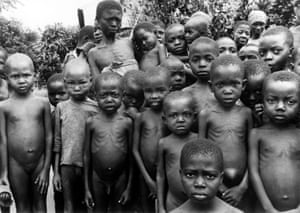
A million children starved to death. I’m haunted by the images I saw there – and by the complicity of the Wilson government
Starving children in a refugee camp near Aba in 1968.
It is a good thing to be proud of one’s country, and I am – most of the time. But it would be impossible to scan the centuries of Britain’s history without coming across a few incidents that evoke not pride but shame. Among those I would list are the creation by British officialdom in South Africa of the concentration camp, to persecute the families of Boers. Add to that the Amritsar massacre of 1919 and the Hola camps set up and run during the struggle against Mau Mau.
But there is one truly disgusting policy practised by our officialdom during the lifetime of anyone over 50, and one word will suffice: Biafra.
This referred to the civil war in Nigeria that ended 50 years ago this month. It stemmed from the decision of the people of the eastern region of that already riot-racked country to strike for independence as the Republic of Biafra. As I learned when I got there as a BBC correspondent, the Biafrans, mostly of the Igbo people, had their reasons.
The federal government in Lagos was a brutal military dictatorship that came to power in 1966 in a bloodbath. During and following that coup, the northern and western regions were swept by a pogrom in which thousands of resident Igbo were slaughtered. The federal government lifted not a finger to help. It was led by an affable British-educated colonel, Yakubu Gowon. But he was a puppet. The true rulers were a group of northern Nigerian colonels. The crisis deepened, and in early 1967 eastern Nigeria, harbouring about 1.8 million refugees, sought restitution. A British-organised conference was held in Ghana and a concordat agreed. But Gowon, returning home, was flatly contradicted by the colonels, who tore up his terms and reneged on the lot. In April the Eastern Region formally seceded and on 7 July, the federal government declared war.
Biafra was led by the Eastern Region’s Oxford-educated former military governor, “Emeka” Ojukwu. London, ignoring all evidence that it was Lagos that reneged on the deal, denounced the secession, made no attempt to mediate and declared total support for Nigeria.
I arrived in the Biafra capital of Enugu on the third day of the war. In London I had been copiously briefed by Gerald Watrous, head of the BBC’s West Africa Service. What I did not know was that he was the obedient servant of the government’s Commonwealth Relations Office (CRO), which believed every word of its high commissioner in Lagos, David Hunt. It took two days in Enugu to realise that everything I had been told was utter garbage.
I had been briefed that the brilliant Nigerian army would suppress the rebellion in two weeks, four at the most. Fortunately the deputy high commissioner in Enugu, Jim Parker, told me what was really happening. It became clear that the rubbish believed by the CRO and the BBC stemmed from our high commissioner in Lagos. A racist and a snob, Hunt expected Africans to leap to attention when he entered the room – which Gowon did. At their single prewar meeting Ojukwu did not. Hunt loathed him at once.
My brief was to report the all-conquering march of the Nigerian army. It did not happen. Naively, I filed this. When my report was broadcast our high commissioner complained to the CRO in London, who passed it on to the BBC – which accused me of pro-rebel bias and recalled me to London. Six months later, in February 1968, fed up with the slavishness of the BBC to Whitehall, I walked out and flew back to west Africa. Ojukwu roared with laughter and allowed me to stay. My condition was that, having rejected British propaganda, I would not publish his either. He agreed.
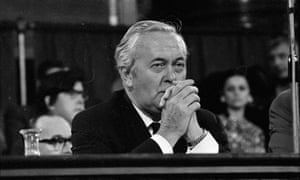
Harold Wilson
 ‘Weapons and ammunition poured in quietly as Whitehall and the Harold Wilson government lied and denied it all.’ Photograph: Wood/Getty Images
But things had changed. British covert interference had become huge. Weapons and ammunition poured in quietly as Whitehall and the Harold Wilson government lied and denied it all. Much enlarged, with fresh weapons and secret advisory teams, the Nigerian army inched across Biafra as the defenders tried to fight back with a few bullets a day. Soviet Ilyushin bombers ranged overhead, dropping 1,000lb bombs on straw villages. But the transformation came in July.
Missionaries had noticed mothers emerging from the deep bush carrying children reduced to living skeletons yet with bloated bellies. Catholic priests recognised the symptoms – kwashiorkor or acute protein deficiency.
That same July the Daily Express cameraman David Cairns ran off a score of rolls of film and took them to London. Back then, the British public had never seen such heartrending images of starved and dying children. When the pictures hit the newsstands the story exploded. There were headlines, questions in the House of Commons, demonstrations, marches.
As the resident guide for foreign news teams I became somewhat overwhelmed. But at last the full secret involvement of the British government started to be exposed and the lies revealed. Wilson came under attack. The story swept Europe then the US.
Donations flooded in. The money could buy food – but how to get it there? Around year’s end the extraordinary Joint Church Aid was born.
The World Council of Churches helped to buy some clapped-out freighter aircraft and gained permission from Portugal to use the offshore island São Tomé as a base. Scandinavian pilots and crew, mostly airline pilots, offered to fly without pay. Joint Church Aid was quickly nicknamed Jesus Christ Airlines. And thus came into being the world’s only illegal mercy air bridge.
On a visit to London in spring 1969 I learned the efforts the British establishment will take to cover up its tracks. Every reporter, peer or parliamentarian who had visited Biafra and reported on what he had seen was smeared as a stooge of Biafra – even the utterly honourable John Hunt, leader of the Everest expedition.
Throughout 1969 the relief planes flew through the night, dodging Nigerian MiG fighters, to deliver their life-giving cargoes of reinforced milk powder to a jungle airstrip. From there trucks took the sacks to the missions, the nuns boiled up the nutriments and kept thousands of children alive.
Karl Jaggi, head of the Red Cross, estimated that up to a million children died, but that at least half a million were saved. As for me, sometimes in the wee small hours I see the stick-like children with the dull eyes and lolling heads, and hear their wails of hunger and the low moans as they died.
What is truly shameful is that this was not done by savages but aided and assisted at every stage by Oxbridge-educated British mandarins. Why? Did they love the corruption-riven, dictator-prone Nigeria? No. From start to finish, it was to cover up that the UK’s assessment of the Nigerian situation was an enormous judgmental screw-up. And, worse: with neutrality and diplomacy from London it could all have been avoided.
Biafra is little discussed in the UK these days – a conflict overshadowed geopolitically by the Vietnam war, which raged at the same time. Yet the sheer nastiness of the British establishment during those three years remains a source of deep shame that we should never forget.
 Frederick Forsyth is a former war correspondent and an author


From;
https://www.theguardian.com/commentisfree/2020/jan/21/buried-50-years-britain-shamesful-role-biafran-war-frederick-forsyth

Thursday, November 7, 2019

BEAUTIFUL FROM THE HEART

A great amazon with a beautiful heart that eloquently radiated on her face.A great heart that touched and continue to touch many through her legacies.
Its 20 years today you left us (too early) but with the greatest gift on earth :PEACE & LOVE for all.

You lagecies will always be upheld.
Continue to Rest in peace mama.

Thursday, October 31, 2019

CHIEF CYPRIAN IBEKWEUDE.. REST IN PEACE

 THE  DEPARTURE  OF A GREAT FATHER AND MAN OF PEACE CHIEF CYPRIAN IBEKWEUDE;  31st November 2019.
 It is naturally painful to miss a figure that has always been present in your life  and memory, but  we  give  the utmost glory  and thanks  to God  for the  blessed time  and life he accorded  to  Pa Ibekwe which he  used to impress positively on  the  community and everyone that came across him.
We in the Chukwubike’s family grew up  knowing his wife(firstly) whom we called ‘Sister Angelina David’. Then we didn’t know the differences  between a Rev Sister and a Nurse because most nurses in our locality  were Rev Sisters  and our Angelina was also a young devoted catholic from a top disciplined family.
She was like  a daughter  to our  father therefore when the young man Cyprian started marrying her we all came to know that ‘Sister was a Nurse’.
Cyprian was a fine and vibrant gentleman and was accepted by her family and MBC also endorsed it.
Pa Ibekwe was was a great father who as a typical Igboman devoted all (without showing it ) his energies to the discipline  and development of  his  family and community.
When he lived  outside Nenwe because of  his business he never missed  to  return regularly  and promptly to attend  to issues in the family  and on every return he never missed to pay homages to MBC. He  relied  so much on my fathers supervision of his  young family and our NURSE was  and is still a fantastic mother.
Pa Ibekwe was  a disciplined person and was lucky to have married  someone  from a strict  disciplined  and educational (catholic) background  no wonder they were blessed  with wonderful children {who one of them is our able and beloved Rev Fr Johnbosco } that  a couple of years ago feasted and honoured  them alive  during their wedding anniversary.We are proud  of these children and  for  setting that pace  for others to follow.
In the community Chief Ibekwe never had  any issues  with anyone in the town. He was always in the midst of all peace movements and committees.
We in the Chukwubike’s  family will always  remember him for  his continuous  closeness to us , especially to our parents  when we  were away and they were sick. We shall always be grateful how  he  and his   wife  continued  to be  their(our parents)  special  family  ‘chief  doctor and nurse’. These priceless friendship and services  will always  be  remembered. As we remember so do others remember him for  his services  to all the families  at home who he continued  to  support in all the ways  he could.
As we say good bye  today  we pray   to the  Good  Lord  to accept your  soul , grant your  wife   and all of  us  the  heart to bear your physical  absence.
Rest in peace
From
Charles O Chukwubike
(for the Chukwubikes family)

COMMENTS

SHAITSU

SHAITSU
Il massaggio Shiatsu che si effettua tramite la pressione delle dita, dei palmi delle mani e dei piedi e dei gomiti su tutto il corpo, agisce sui punti energetici considerati dall'agopuntura. Stimola la circolazione sanguigna ed il flusso linfatico, agisce sul sistema nervoso allentando la tensione muscolare più profonda, rimuove le tossine dei tessuti, risveglia il sistema ormonale e sollecita la capacità di autoguarigione del corpo.

FeedCount

Live Traffic Feed

Followers